

When footballers get caught with a pouch under their lip, the headlines call it snus. Most of the time, it is not. The product most professional players use today is a white, tobacco-free pouch that delivers nicotine without any tobacco leaf - a meaningfully different product with a different risk profile.
This article covers what nicotine actually does for footballers, which players have been reported using it, why they choose it over cigarettes and vapes, and where the rules stand right now.
Quick answers:
- Most players who say "snus" are using tobacco-free nicotine pouches, not traditional tobacco snus
- Nicotine may improve short-term alertness and focus - effects vary by dose and tolerance, and there is no evidence it improves sprint speed or aerobic capacity
- Players use pouches primarily for stress relief, pre-match routine, and as a substitute for smoking or vaping
- Snus and nicotine pouches are not on the WADA Prohibited List (at time of writing - see Sources)
- Main risks are nicotine dependence, sleep disruption, and oral irritation; traditional tobacco snus carries additional tobacco-specific health risks
Table Of Contents
Does Snus Give You Energy?
Yes, in a limited sense. Nicotine triggers adrenaline and dopamine release, which creates a short burst of alertness and elevated mood. Footballers consistently describe feeling more switched on after use, and the effect is noticeable enough during training and on match day to explain why the habit sticks.
The effect kicks in within a few minutes of placing a pouch under the upper lip. It lasts between 30 and 60 minutes depending on nicotine strength and individual tolerance. One or two pouches typically cover a 90-minute match. At higher doses or with low tolerance, though, the stimulant effect can tip into jitteriness or increased anxiety - both counterproductive for performance.
Nicotine does not improve physical output. It does not increase lung capacity, sprint speed, or VO2 max. The boost is entirely cognitive and mood-based. That distinction is exactly why WADA sits it in a monitoring category rather than treating it as a prohibited performance-enhancing substance.
Which Footballers Use Snus or Nicotine Pouches?
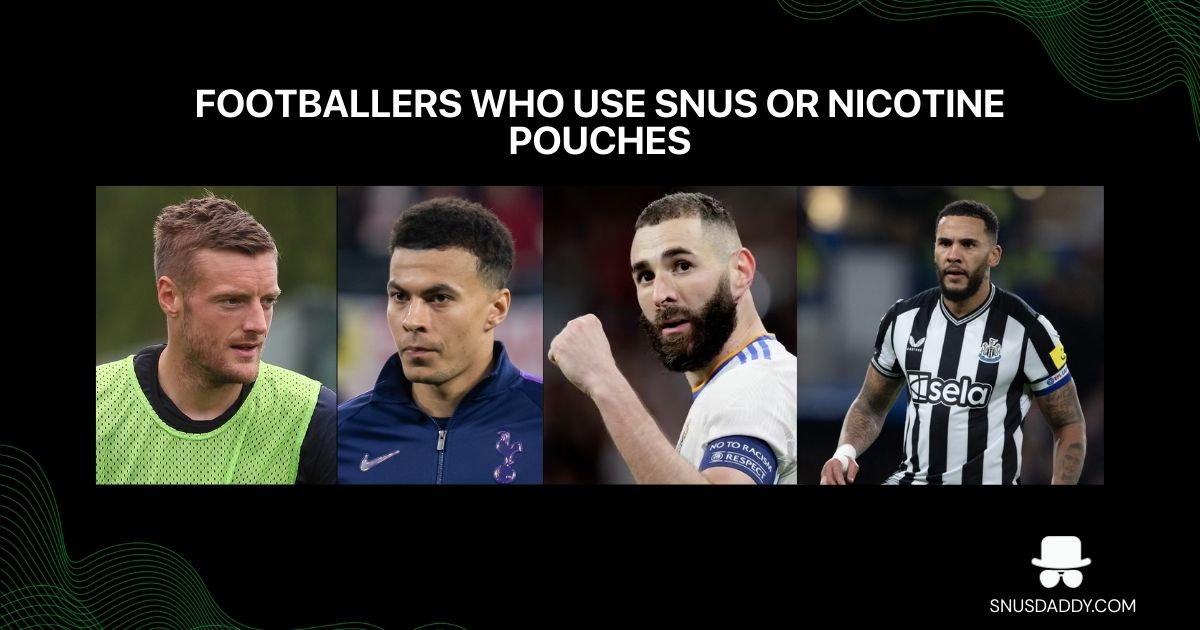
The players publicly linked to snus or nicotine pouch use span multiple top-flight leagues. Here are the most documented examples:
- Jamie Vardy - The former Leicester City striker has spoken openly about snus use, and his profile helped bring the topic into mainstream UK football coverage.
- Dele Alli - The former Tottenham Hotspur and England midfielder was photographed in press coverage in 2023 in proximity to snus products, with several UK outlets linking him to their use.
- Karim Benzema - The Real Madrid and France international was reported by European football media as among the high-profile players linked to snus use.
- James Lascelles - Referenced in PFA educational materials as a player who has spoken about nicotine pouch use.
The scale of use across the sport is significant. A self-reported survey conducted by the Professional Footballers' Association (PFA) and Loughborough University in 2024 found that approximately one in five male and female professional footballers reported using snus or nicotine pouches. The survey measured prevalence through self-reporting, not clinical testing, so it shows how common use is - not whether it affects performance. The same study found female players reported higher rates of nicotine dependence than male players.
The PFA study also confirmed what reporters often get wrong: most players who say "snus" are actually using nicotine pouches. Use spread into English football largely through Scandinavian players and has since moved through the Premier League and into lower divisions.
Snus vs Nicotine Pouches: What's the Difference?
These terms get used interchangeably in football coverage, but they are different products.
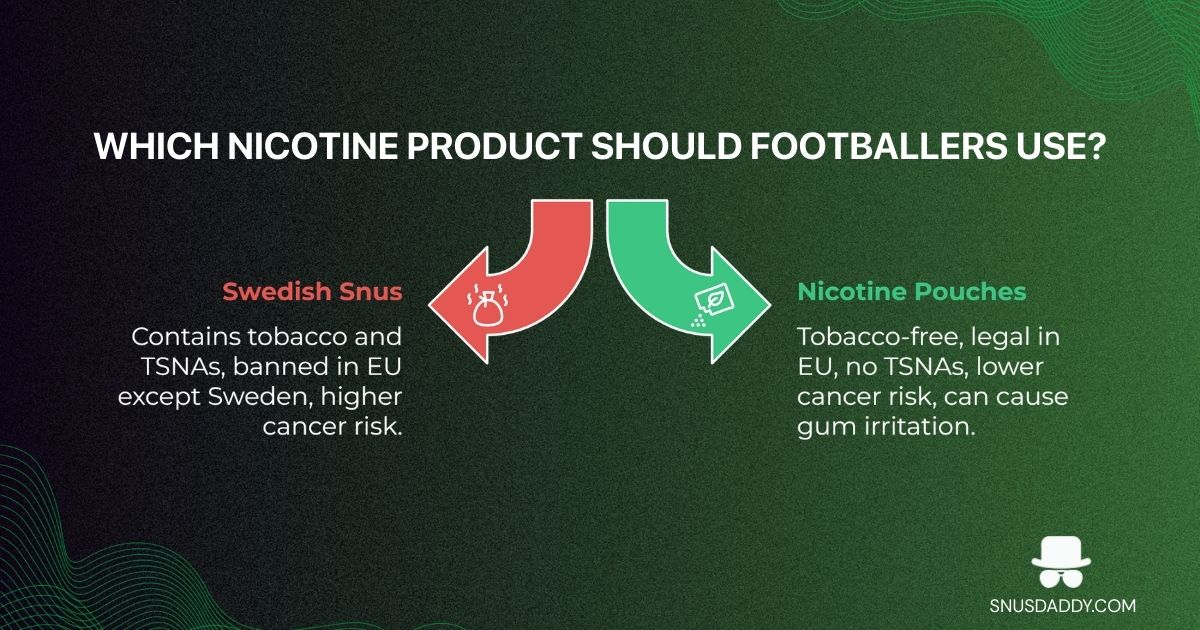
Swedish snus is an oral tobacco product made from pasteurized tobacco leaf. It comes in a moist format, sits under the upper lip, and is banned for commercial sale across the EU except in Sweden. It contains tobacco-specific nitrosamines (TSNAs), which are associated with elevated risk of oral cancer and periodontal disease with long-term use.
Nicotine pouches contain no tobacco leaf at all. They use a plant-based fiber blend to deliver nicotine. They are white, dry or semi-dry, and legal across the EU. They do not contain TSNAs, though they still carry nicotine dependence risk and can cause gum irritation with regular use. For a full breakdown of how the two compare, see Snus vs ZYN: What's the Difference.
The football coverage, PFA research, and most player references to "snus" in the UK and European context are describing nicotine pouches. Snusdaddy does not stock traditional snus. Everything in the range is a white, tobacco-free pouch.
Why Do Footballers Use Nicotine Pouches?
Several distinct reasons come up consistently, and most go beyond a simple preference for nicotine:
- Stress relief and anxiety management - Nicotine acts as a short-term anxiolytic for regular users. The psychological pressure of professional football is significant, and players use pouches as a coping tool before and during matches.
- Pre-match focus routine - For players who use regularly, a pouch before warm-up has become part of a routine that signals readiness. The ritual component matters as much as the pharmacological one.
- Nicotine maintenance - A portion of users are managing existing dependence. Stopping creates withdrawal symptoms - irritability, poor concentration, disrupted sleep - that players understandably want to avoid around fixtures.
- Discreet use during travel and team time - Pouches are odourless, invisible in use, and require no device or flame. They work on planes, in hotels, and in team environments where smoking or vaping is not practical or permitted.
- Substitute for smoking or vaping - Cigarettes damage cardiovascular capacity over time. Vaping produces phlegm that affects stamina. Both carry reputational risk for professional athletes. A pouch delivers the same nicotine hit without the performance cost or visibility.
The PFA's concern is not that players are making an uninformed choice in all cases - it is that many players, particularly younger ones, do not fully understand the dependence risk before habits form.
Side Effects for Footballers
Nicotine is addictive. Regular use affects recovery and performance in ways that are not always immediately obvious.
A 2023 study published in the journal Substance Abuse: Research and Treatment found that regular snus use disrupts sleep and dietary patterns due to its stimulant and addictive properties. For athletes whose performance depends heavily on sleep quality and recovery, this is a meaningful risk that gets underweighted in the "snus helps me focus" framing.
The less obvious effects matter just as much for footballers specifically:
- Sleep and recovery - Nicotine use late in the day delays sleep onset and reduces sleep quality. Players using pouches in evening training sessions or post-match may see sleep quality and recovery suffer over time.
- Heart rate and cardiovascular response - Nicotine raises heart rate and blood pressure temporarily. This is manageable for most players during low-intensity periods but adds load during sustained aerobic effort.
- Dry mouth and hydration - Pouches reduce saliva production. Footballers already lose significant fluid through a 90-minute match, and dry mouth compounds this.
- Gum irritation - Placing a pouch in the same spot repeatedly causes local irritation and, with long-term use, gum recession.
- Dependence and motivation without nicotine - Long-term users often report difficulty with concentration and motivation on days they do not use. The PFA flagged this pattern specifically in its educational materials as a concern for player welfare.
Traditional tobacco snus carries all of the above plus an elevated risk of oral cancer and periodontal disease from TSNAs. Nicotine pouches sidestep those tobacco-specific dangers. The dependence profile, though, is identical.
Is Snus Illegal in Football?
No. Neither snus nor nicotine pouches are on the WADA Prohibited List. WADA placed nicotine on its monitoring list in 2012 following evidence of widespread use across professional sport, but monitoring does not constitute prohibition. As of the last review of this article, both products remain legal in competition.
Individual clubs have introduced their own responses. A number of Premier League clubs have run PFA-led educational sessions to ensure players understand the addiction risk before habits form. These are welfare interventions, not sporting rules. Players face no sporting sanction for using either product.
Two regulatory frameworks often get confused in football snus coverage:
- Sporting regulation - Governed by WADA and individual governing bodies. Neither snus nor nicotine pouches are prohibited.
- Retail legality - Traditional tobacco snus is banned for commercial sale across most of the EU. This is a consumer product regulation with no bearing on whether a player can use the product.
Frequently Asked Questions
What is the difference between snus and nicotine pouches?
Traditional snus contains tobacco leaf and is banned for commercial sale across most of the EU. Nicotine pouches contain no tobacco - they use plant-based fibers to deliver nicotine and do not contain tobacco-specific nitrosamines. Most footballers described in media coverage as "using snus" are using nicotine pouches.
Can snus affect a footballer's cardiovascular performance?
Nicotine raises heart rate and blood pressure temporarily. This does not significantly impair performance during a single match for most users, but regular use can disrupt sleep quality and recovery, which affects performance over time.
Are there any regulations on snus use in professional football?
WADA monitors snus but has not banned it. No professional football governing body currently prohibits snus or nicotine pouch use. Several clubs have internal welfare policies discouraging use, but none carry sporting penalties.
How long does the effect of a nicotine pouch last during a match?
A nicotine pouch delivers its effect for 30 to 60 minutes depending on strength and individual tolerance. For a 90-minute game, players may use one or two pouches. Higher-strength pouches used without tolerance can cause jitteriness rather than focus.
Snus in Football: The Short Version
Most footballers using "snus" are using white, tobacco-free pouches. Nicotine improves short-term alertness and mood - it does not make players faster or fitter. Pouches win over cigarettes and vapes because they deliver the same nicotine hit without the lung damage or stamina cost. The dependence risk is real and the PFA treats it seriously, but neither product is banned by WADA or any football governing body.
Browse the full range of nicotine pouches at Snusdaddy.
Sources
- PFA and Loughborough University (2024). Survey on snus and nicotine pouch use among professional footballers. Loughborough University News
- Substance Abuse: Research and Treatment (2023). Study on snus use, sleep, and dietary disruption. NCBI
- WADA Monitoring Program - current status of snus. WADA Monitoring Program
- Cardiovascular effects of smokeless tobacco. NCBI
